Intercontinental Phenomenology Research Seminar
Mission
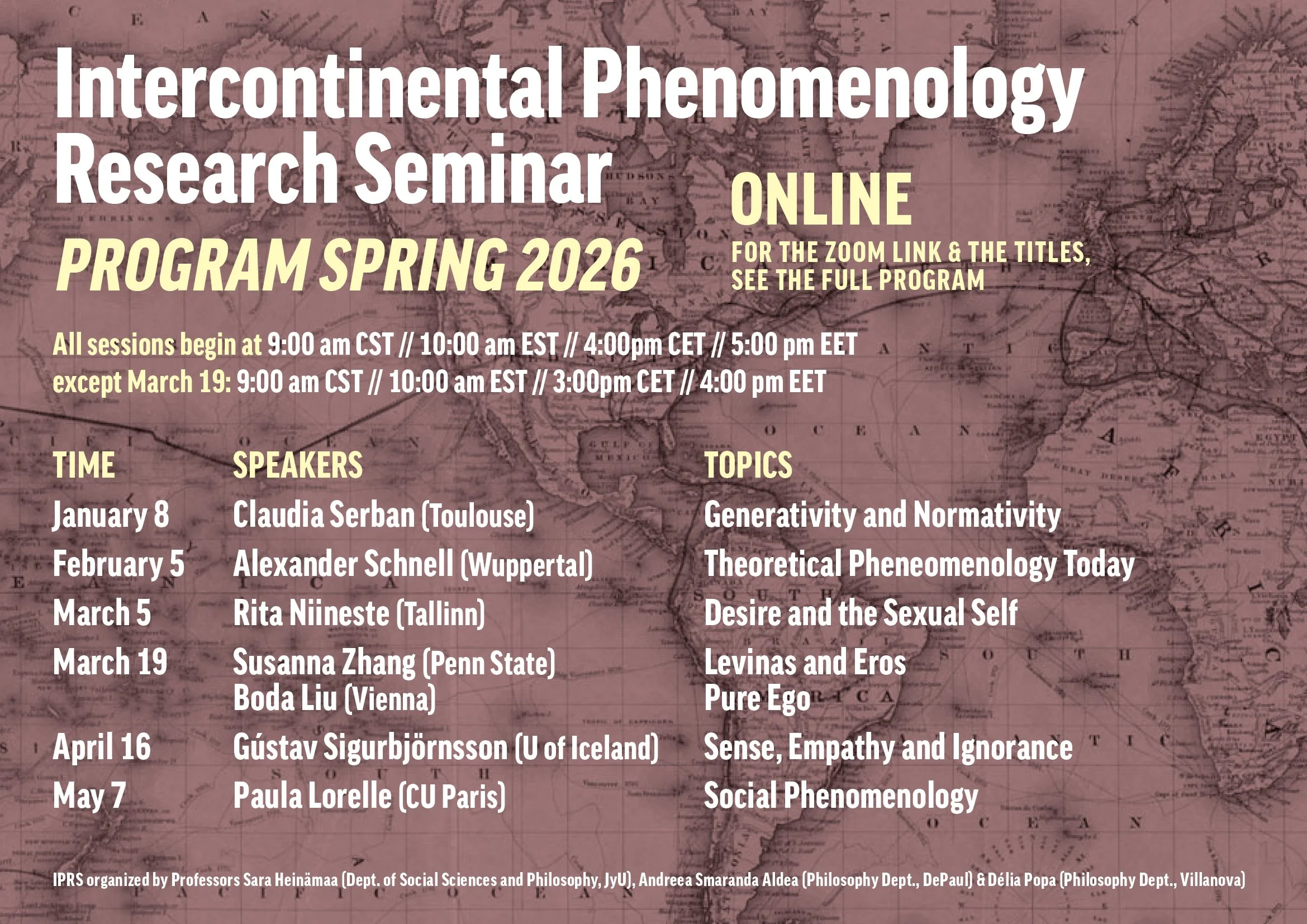
IPRS is designed to function as a platform for rigorous scholarship and dialogue in phenomenological research today. As the seminar title suggests, our goal is to bring together scholars from all corners of the globe whose diversely innovative approaches contribute to the field and expand it. We are especially committed to supporting junior scholars and scholars whose work in progress would benefit from the in-depth feedback (including Ph.D. students who are currently working on their theses). Each session has an extensive, 60-75 minutes discussion period built into it, which our speakers have found most productive. Over the course of our first year, our community has grown and many participants chose to return to sessions. Our continued conversations in IPRS have already led to substantial collaborative and mentoring work. As we grow, we remain open to new approaches and initiatives, so feel free to join the seminar.
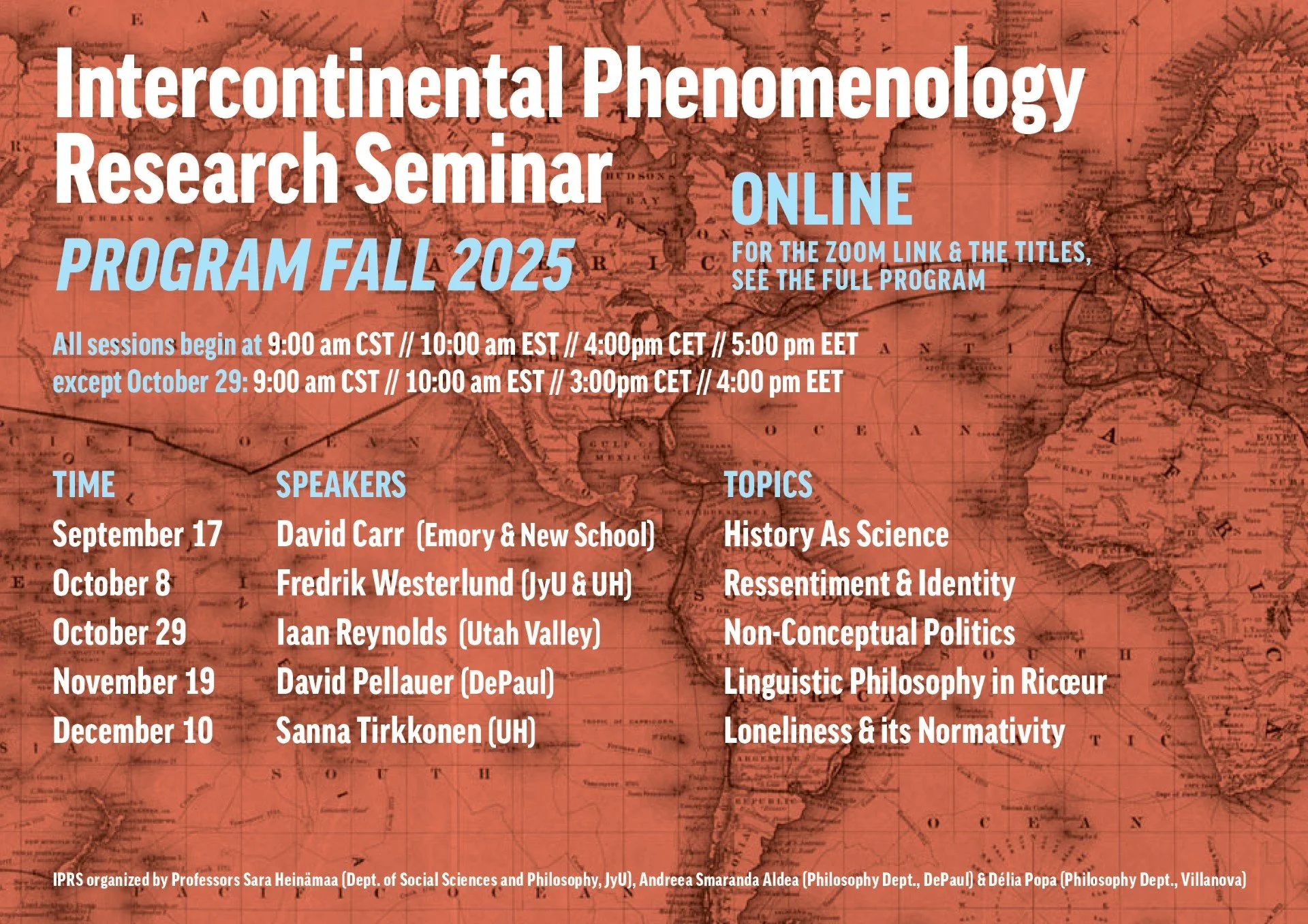
Fall 2026 Program
During Fall 2026, IPRS will be offering a joint lecture series in collaboration with the Political Phenomenology In Debate group based in Germany (Hagen, Darmstadt, Köln). For more information on our Fall 2026 series, including the Zoom link, see below. To learn more about the Political Phenomenology In Debate group, click HERE.
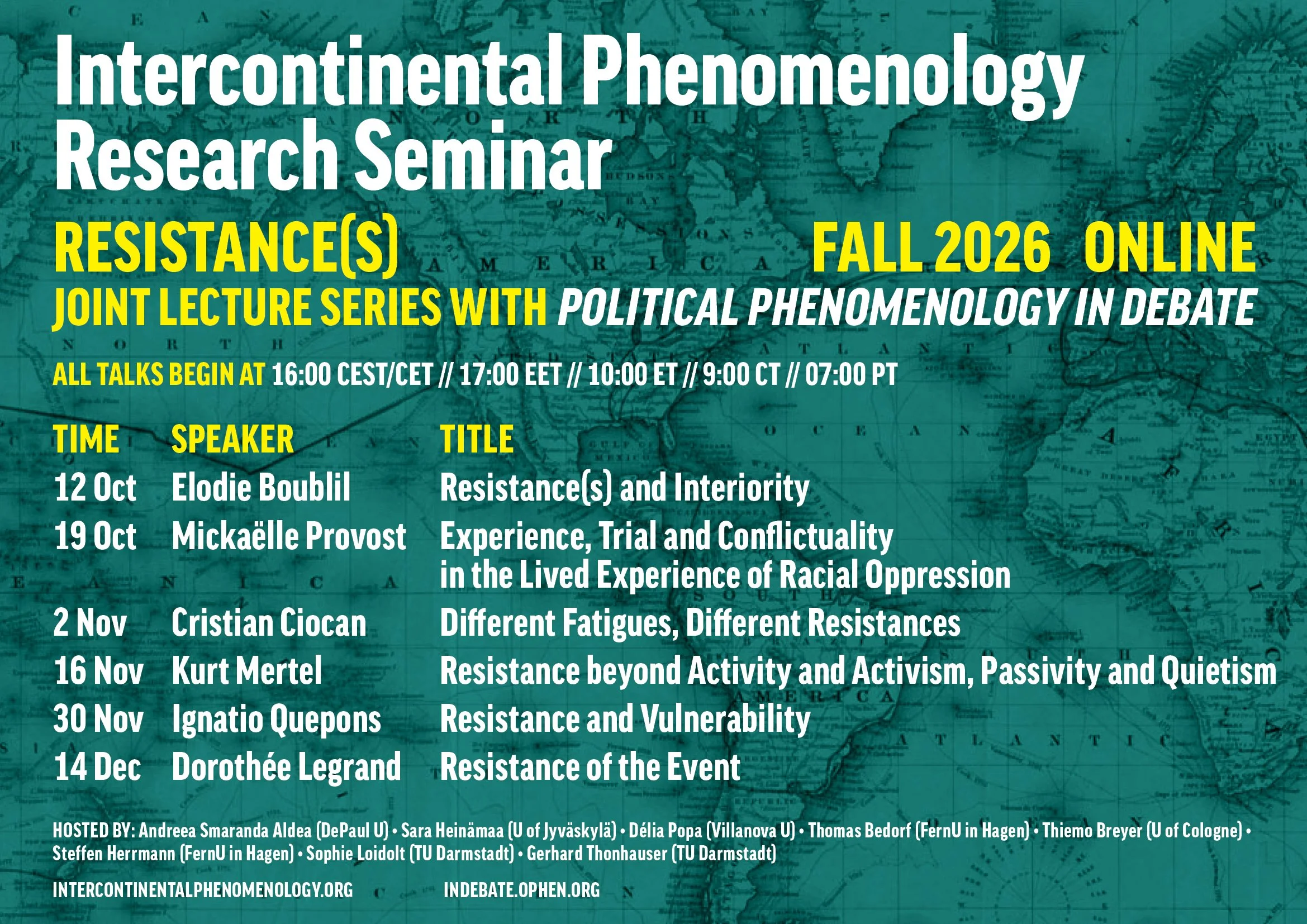
Click HERE or on the flyer above to be redirected to the Zoom Room.
Meeting ID: 649 3064 5316
Passcode: 06410388
Political resistance is never merely an abstract opposition to unfair systems of power, pressure or naturalized social norms. It is lived in human bodies, social relations, political institutions, and shared worlds, where our position is constantly questioned and modified. From a political-phenomenological perspective, resistance becomes possible wherever subjects encounter limits, endure exhaustion and vulnerability, contest forms of oppression or disrupt sedimented orders. The lecture series asks how such experiences reshape agency, conflict, and collective life – and if acts of resisting can disclose new possibilities of freedom and transformation.
Fall 2026 Presentations Titles & Abstracts
Elodie Boublil -– Resistance(s) and Interiority
Phenomenological approaches to interiority have sought to rethink this concept, breaking with the Cartesian conception of an inner space that is distinctly separate from a material and corporeal "exterior". In this presentation, I explore further the critical and fruitful connections between a phenomenological understanding of interiority and the forms that resistance can take in our fragmented world. At the intersection of critical phenomenology and a phenomenological approach to contemporary critiques of Cartesian interiority, I argue that the multifaceted resistance of subjectivity is crucial to understand the contemporary reconfigurations of the Lebenswelt and assess its anthropological, historical, and political orientations.
Mickaëlle Provost – Experience, Trial and Conflictuality in the Lived Experience of Racial Oppression
Drawing on the works of Frantz Fanon and Abdelmalek Sayad, this presentation explores the methodological difficulties raised by the description of racial oppression when it escapes subjective interpretation and verbalization. Focusing on situations where oppression is not “experienced” in the sense of a singularized and appropriable event, it examines the possibilities offered by theoretical narrative to reconstruct these experiences. Finally, it proposes a gradual conception of resistance, attentive to the pre-reflexive forms of conflictuality at the heart of the experience, beyond the classic schema of “awareness.”
Cristian Ciocan – Different Fatigues, Different Resistances
This talk explores the question of resistance through the lens of a phenomenology of fatigue. It argues that the term “fatigue” covers a plurality of distinct experiential structures unfolding on different levels: individual, relational, and social-political. Each form of fatigue transforms our presence to ourselves, our capacity to act, our relation to others, and our way of inhabiting the world. Accordingly, different fatigues call for different forms of resistance. Yet, the notion of resistance itself proves to be fundamentally ambivalent, since it designates both the resistance encountered in the world, from which fatigue arises, and the the resistance by which the subject responds to fatigue. The talk argues that these two senses are intrinsically connected and illuminate one another, thereby disclosing the phenomenological structure of both fatigue and resistance.
Kurt Mertel – Resistance beyond Activity and Activism, Passivity and Quietism: The Emancipatory Project of the “Early” and “Late” Heidegger
One of the most common ways in which the distinction – and corresponding incommensurability – between the “early” and the “late” Heidegger has been developed is in terms of “activism” vs. “quietism”. By adopting the former, agency is won at the expense of an account of the broader social-historical forces that shape it and, therefore, remains naïvely voluntaristic. Endorsing the latter, by contrast, secures a compelling diagnosis of the historical epoch of technics at the expense of possibilities for emancipation. This picture not only misses the fact that the “late” belongs to and is the fulfillment of the “early” (emancipatory) project, but that it only appears to endorse “passivity” or “quietism” on the presupposition of a causal account of agency and a form of dialectical negativity that is its corollary. But the “early” project of fundamental ontology was crucially animated by the dismantling of the causal model of agency and the passive/active distinction that is a holdover from the metaphysical tradition, an endeavor further developed and radicalized in Heidegger’s later work. Hence, I argue that in order to better understand the relationship between the “early” and “late” projects and, more importantly, to elaborate an account of resistance in the age of Ge-stell that does not participate in its reproduction, it is necessary to attend to the guiding thread of Heidegger’s critique of agency as causality and negativity as dialectics.
Ignatio Quepons – Resistance and Vulnerability: Ethical Implications of the Experience of Injustice
The presentation outlines a phenomenological interpretation of Luis Villoro’s criticism to formalist approaches to the idea of justice by suggesting an alternative that takes as its point of departure the historical experiences of injustices as the axis that allows us to glimpse an elucidation of the notion of justice via negativa. Furthermore, it is possible to compare this approach to the moral thought of T.W. Adorno to emphasize the relevance of notions such as negativity, vulnerability, and resistance in Villoro’s argument. Departing from the points of convergence between Villoro´s disruptive ethics and Adorno´s moral thought, I suggest a consideration of whether a phenomenological approach to the reconstruction of the normative sphere is possible starting from negative and historical experiences related to the condition of vulnerability rather to the habitual understanding of experiencing of values from acts of intuitive enjoyment or positive fulfillments, and if from such account it is possible to understand our ethical undertakings in terms of resistance.
Dorothée Legrand – Resistance of the event – Deconstruction, Psychoanalysis and Ethics.
Building on the distinction (highlighted by Derrida) between constative and performative speech acts, on the one hand, and the event, on the other, we shall attempt to specify a resistance to knowledge and to power. Is it the resistance of an irreducible otherness which, nonetheless, addresses me, speaks to me (Levinas); is it the resistance to symbolisation of the real (Lacan)? How may one respond to, how may one take responsibility for this resistance, which insistently imposes itself, breaks in, interrupts? How may we leave a place for such resistance within our lives, and in our institutions? We shall attempt to characterise an ethical response to, and responsibility towards the event’s resistance – which may provide an ethical resistance to (the reduction of the social field to) politics.
About the Organizers

Andreea Smaranda Aldea is Associate Professor of Philosophy at DePaul University. She earned her Ph.D. at Emory University. She has held research appointments as Postdoctoral Mellon Fellow in Philosophy at Dartmouth College, (2012-2014), Fulbright Finland Research Scholar (2019-2020), and Kone Foundation Finland Senior Research Scholar (2019-2021).
In her research, which has appeared in numerous articles and book chapters, she focuses on phenomenological methods, possibility constitution, conceivability, imagination, memory, the normativity and teleology of experiential life, critical philosophy, feminist philosophy, and phenomenological psychopathology.
She is the co-editor of a special issue of Continental Philosophy Review (with Amy Allen, 2016), entitled “The Historical A Priori in Husserl and Foucault” and of a special issue of Husserl Studies (with Julia Jansen, 2020) entitled “Imagination in Husserlian Phenomenology: Variations and Modalities.” She has co-edited Phenomenology as Critique: Why Method Matters (with David Carr and Sara Heinämaa, Routledge 2022) and Doing a Phenomenology of Political Life – Social Critique, Sense-Institution, and Political Imagination (with Délia Popa, Springer 2025). Together with Délia Popa and Christian Ferencz-Flatz, she is founding co-editor of the Springer book series New Directions in Phenomenology. She is currently finishing her book Limits, Possibilities, and Beyond – Transcendental Phenomenology as Radical Critique of the Present.
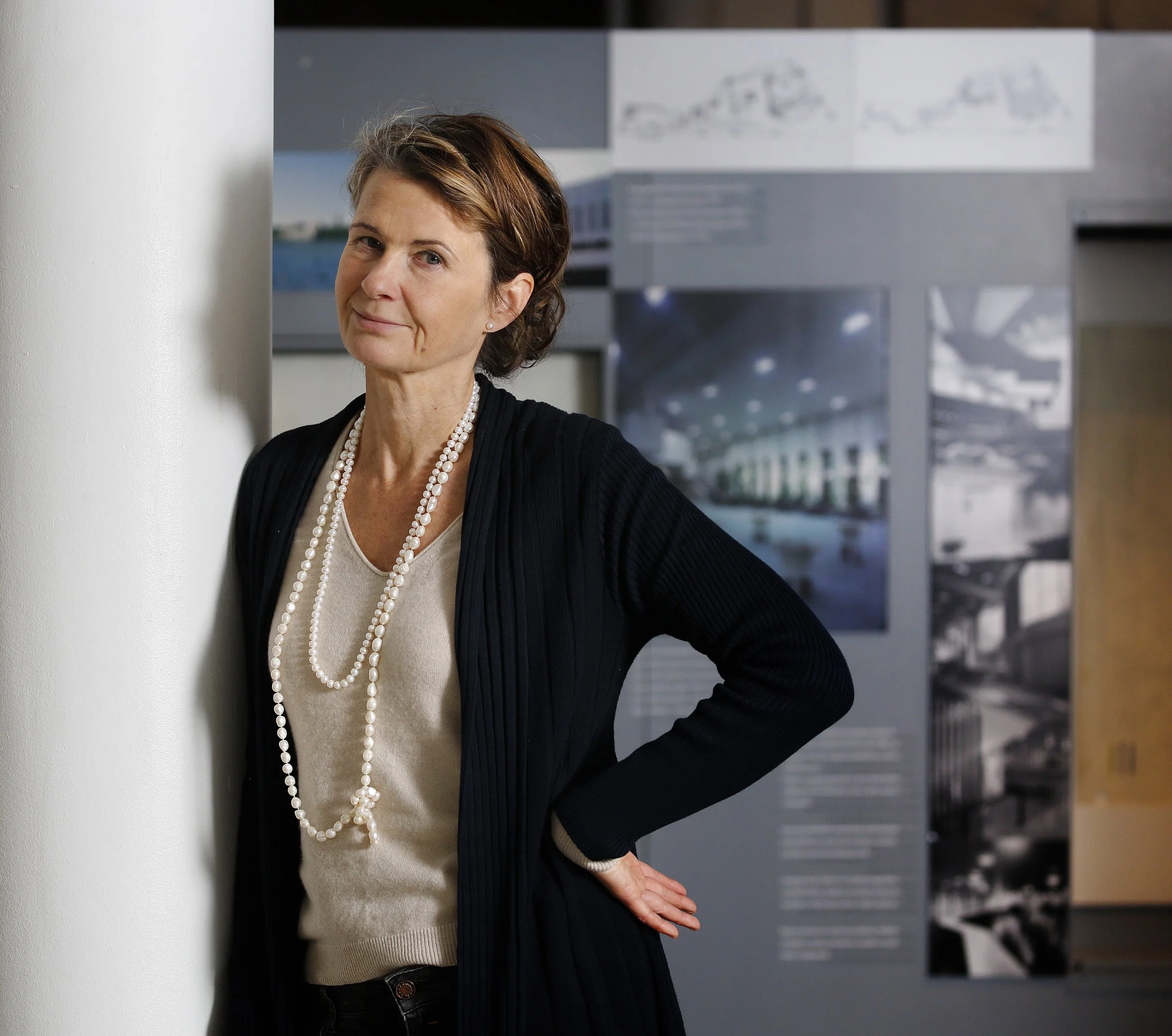
Sara Heinämaa is Professor of Philosophy at the University of Jyväskylä and Docent of Theoretical Philosophy at the University of Helsinki. In 2017–2022, she worked as Academy Professor of the Academy of Finland, leading a six-year research project on the phenomenology of normality, titled Marginalization and Experience. Prior to these posts she has worked as Professor of Philosophy and Professor of Gender Studies at the universities of Uppsala Sweden, Helsinki Finland, Oslo Norway and Turku Finland.
In her systematic work, Heinämaa investigates the structures of embodiment, intersubjectivity and temporality and theorizes the roles of emotions and norms in ethics and politics. She has published numerous articles on these topics, contributing to the development of phenomenology, existential philosophy, philosophy of mind and history of philosophy.
She is co-editor with Anthony J. Steinbock of a new book series, Husserlian Legacies: Themes for the 21s Century, which just released its first volume, Values of Love and Ethical Reflection (2025). Her other publications include Contemporary Phenomenologies of Normativity (with Hirvonen and Hartimo 2022), Phenomenology as Critique (with Aldea and Carr 2022), Phenomenology and the Transcendental (with Hartimo and Miettinen 2014), Birth, Death, and Femininity (with Schott et al. 2010) and Toward A Phenomenology of Sexual Difference (2003).

Délia Popa is an Associate Professor of Philosophy at Villanova University, where she teaches phenomenology, existentialism, contemporary French philosophy, as well as the philosophy of psychoanalysis, of literature, and of film. Between 2020 and 2023, she was part of a research team working on the project Structures of Bodily Interaction, studying the phenomenology of gestures from an interdisciplinary perspective. Aside from her position at Villanova University, she has also taught at Haverford College, Université Catholique de Louvain, and Université de Nice.
Her research aims at bringing together phenomenological investigation and social critique. She has published numerous studies on the phenomenology of imagination, with an interest in examining its methodological dimension from a social and political perspective. Her current research focuses on the problem of becoming a stranger, social exclusion, and transclass experiences, with a new project on a feminist phenomenology of the sexual difference.
She is founding co-editor of the Springer book series New Directions in Phenomenology with Andreea Smaranda Aldea and Christian Ferencz-Flatz. She is the author of Apparence et réalité. Phénoménologie et psychologie de l’imagination (Olms, 2012) and co-editor of La portée pratique de la phénoménologie. Normativité, critique sociale et psychopathologie (2014), Approches phénoménologiques de l’inconscient (2015), Describing the Unconscious. Phenomenological Perspectives on the Subject of Psychoanalysis (2020).
Past Programs